

| Start of section
Production, amateur Radio amateurs Aircraft model, rocket-model Useful, entertaining |
Stealth Master
Electronics Physics Technologies Inventions |
Secrets of the cosmos
Secrets of the Earth Secrets of the Ocean Tricks Map of section |
  |
| Use of the site materials is allowed subject to the link (for websites - hyperlinks) | |||
Navigation: => |
Home / Electronics / Schematics / Repair schemes / |
|

Method of slag shooting with preset current value
In the zone of electrical breakdown
See also: |
Basically, the methods of reconstructing the picture tubes were developed in 50 ... 60 years, now the descriptions of the devices and methods of reconstructing the kinescope are rare. Nevertheless, an instrument of this type is necessary even today to any master who repairs TV sets or monitors. Summarizing the experience with different devices, I propose my own version. It differs in that it provides for the possibility of presetting the value of the current in the zone of electric breakdown. This solution, combined with ease of use, is a new solution in the regeneration of cathodes.
The device is compact and easy to use, and in efficiency is slightly different from sophisticated branded devices in large elegant cases. It does not require a set of replaceable panels for different types of kinescope. Result of restoration is observed immediately on the TV screen. Over the years of operation, the circuitry of the device has been well worked out, the cost is low, it can be assembled and adjusted even by a radio amateur. No TV or monitor has suffered for many years of application of the device, but, nevertheless, a warning: the author is not responsible for the consequences of using the proposed method and device .
Schematic diagram of the device is shown in Figure 1. The device consists of a power supply and a limiter-modulator. The power supply of the device includes components T1, D2, C1, C2. The rectifier on D2 through current-limiting resistors charges capacitors C1 and C2 to a voltage of 400 ... 450 V. The energy of the capacitor C2 is used for discharge in the kinescope through the modulator-limiter on Q1. The control voltage to the limiter-modulator is supplied from the capacitor C1. Independent power supply allows to maintain the stability of the limiter characteristics when the capacitor C2 is discharged. To modulate the current source, the reverse winding uses the winding III of the transformer T1. The depth of current modulation is set by resistor R4 within 40 ... 60%. The current limit within 30 ... 800 mA is set by resistor R7. The red D3 LED is used as a stabilizer for the base voltage and the indicator. Resistor R8 sets the value of the maximum current in the discharge circuit. Resistor R6 restrictive, R9 - current sensor. Transistor Q1 can be applied like BU508, S2000 or similar, but without a resistor in the base-emitter circuit. The average power dissipated on the transistor is small, so you can do without a radiator. Diode D2 type BYW54 or any pulse, with a reverse voltage of not less than 600 V. Transformer T1 is wound on a ferrite core from the mains filter of the power supply of a TV or monitor, the dimensions of the core are not critical due to low power consumption. Winding I contains 20 turns of wire 0.53 mm, winding II - 180 ... 200 turns of wire 0.12 mm, winding III contains 30 turns of the same wire.
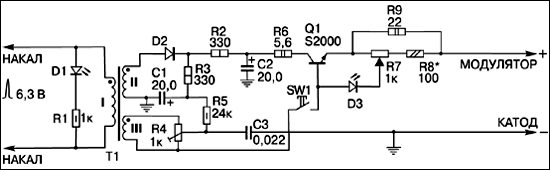
Figure 1. Schematic diagram of the device
Structurally, the device is made in a compact plastic case. The positive terminal of the device and the wires of its connection to the glow plugs are equipped with "crocodiles". It is convenient to arrange a negative conclusion in the form of a probe, which is a thick metal needle, mounted in the body from a felt-tip pen. In the same probe, it is convenient to place the button SW1.
Operation with the device is as follows. We connect the power terminals with the help of "crocodiles" to the ends of the glow tube of a working TV. The correct connection is determined by the illumination of the LED D1. After a few seconds, necessary to charge the capacitors, the device is ready for operation. The positive terminal is connected to the modulator (most often it is a common wire), negative to the restored cathode. By setting the current to minimum, close the button SW1. The regeneration result is checked by the quality of the image on the screen after the device is disconnected from the cathode. Figure 2 shows the output waveform. If necessary, increase the current resistor R7, turn on the device and again check the result. Thus, gradually increasing the current, you can least "traumatically" affect the cathodes of any kinescope.
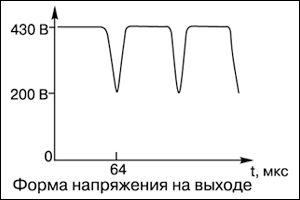
Figure 2. The shape of the output signal
In some models of TVs, the protection may be activated during regeneration. In this case, the TV is restarted by re-enabling and the process can be continued. Many years of practice of using this device showed that there are no defects in TVs. If necessary, switching off the glow voltage of the kinescope can be simulated simply by turning off the TV. The temperature inertia of cathodes and the energy stored in the capacitors of the device allow regeneration to be carried out while maintaining the necessary regimes. To supply negative voltage, which is recommended in some techniques, you just need to swap the terminals connected to the kinescope. In order to use the device in tube TVs or monitors that do not have pulse heat, one must wind a temporary additional winding from 3 ... 5 turns to the line transformer and connect the power terminals of the device to it.
Attention!
When working with the device, do not forget the safety rules!
Date of publication 22.03.2003.


Comments
Commenting on, remember that the content and tone of your message can hurt the feelings of real people, show respect and tolerance to your interlocutors even if you do not share their opinion, your behavior in the conditions of freedom of expression and anonymity provided by the Internet, changes Not only virtual, but also the real world. All comments are hidden from the index, spam is controlled.