

| section Home
Production, Amateur Radio amateur Model aircraft, rocket- Useful, entertaining |
Stealth master
Electronics Physics Technologies invention |
space Mystery
Earth Mysteries Secrets of the Ocean Stealth section Map |
  |
| Use of material is permitted for reference (for websites - hyperlinks) | |||
Navigation: => |
Home / Electronics / Circuits / Special devices ... / |
|

Night-vision device
their own hands
Any body has the ability to emit or reflect infrared (IR) rays. On this principle and built a "night vision" (night vision), developed in 1984 by the German company "Elektrisch Manufactur". This device is based on the internal photoelectric effect.
When projecting IR image the electrical conductivity of the irradiated areas of semiconductors (2) (see Figure 1) changes and adjacent electroluminescent layer (4) creates a potential distribution corresponding to the distribution of the brightness of the image on the photoconductor (2).
For this process it is necessary to take extreme transparent electrodes to apply an AC voltage of 250-500 volts with a frequency of 400-3000 Hz and the current intensity to 10 mA

Fig.1 |
|
So, we proceed to the production of night vision devices. Chemical elements necessary for the manufacture of the device, you can get in any chemical office or school chemistry lab of any enterprise.
To begin with we take two glass plates, tin chloride SnClz, silver sulfide ZnS zinc (crystalline) and copper. Glasses hold 4:00 in a mixture of H2SO4 and K2Sg2O7 (potassium dichromate). Dry. Then take a porcelain cup, put it in SnCl2 and put in a muffle (or electric) oven. Above it at a distance 7-10sm secure windows. Cover the cup of a metal plate and turn on the oven.
As soon as she warmed up to 400-480 degrees, remove the metal plate. Once formed the thinnest conductive cover, turn off the oven and leave the glass in it to cool down completely. Covering check tester. Then, on one of these plates put of semiconductors. To do this, prepare the equal amount of a 3% solution of thio-urea Na4 C (S) NH2 and 6% lead acetate solution. Pour the two solutions in a glass jar. Using tweezers, make a solution of a glass plate and keep it upright. But before you put on the side free of conductive lacquer coating. Wearing rubber gloves, pour into a container with plates, top to a concentrated solution of alkali / care !! / and very gently stir with a glass rod without touching the plate. After 10 minutes, the plate remove (gently) and wash under running distilled water. Dry. Turn on the oven and place in a clean porcelain cup silver. Repeat the above process at 900 degrees. The coating is applied to the plate of semiconductors. Get produce mirror films. To manufacture the phosphor prepare pure crystals of ZnS. If there are any impurities, the brightness decreases sharply or disappear. Prepare the oven. In a porcelain cup put pure copper. Crystals of copper and ZnS should be as small as possible. Observe the proportion of ZnS - 100%, Cu (copper) - 10%. In the furnace to create the circulation of copper vapor and passing them through the spaces between the crystals. The resulting crystals are not in any way to grind. It must obtain a colorless powder. Mix tsapon nail with crystals. The amount of varnish, take the minimum possible. Pour the mixture onto a plate with a silver layer and wait until the spreading and the formation of a flat surface. Above apply a second plate conductive coating on the nail and press gently. After drying over pressurize the resulting PNV. Before all these operations, after applying a conductive coating to be soldered wiring as the conclusions on the edges of the plates.
Do you still now gather the high voltage generator circuit and assemble it all in a single housing. It can be any shape. However, it is recommended nevertheless proposed by the developer (see figure 2). The lens can be from any camera, preferably a short-throw, such as "FED", "Shift-M." Eyepiece can be any biconvex lens. After final assembly, check all connections are correctly connected and strength. By incorporating NVD dolzhet quietly squeaked transformer. If the image does not appear do not despair. Change the generator frequency or voltage level. Set the maximum sensitivity.
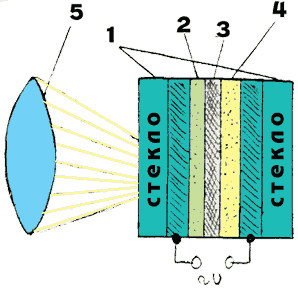
Fig.2
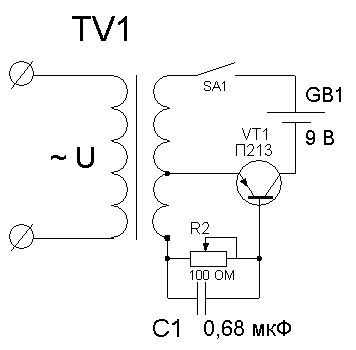
Figure 3
Resistor R2 varies the oscillator frequency.
The transformer is wound onto the core and comprises either:
Winding I contains 2000 - 2500 turns of wire - 0.05 - 0.1 mm;
Winding II comprises 60 turns;
Winding III - 26 turns, wire - 0.3 mm.
Publication date 29.11.2003gg.


Comments
Commenting, keep in mind that the content and the tone of your messages can hurt the feelings of real people, show respect and tolerance to his interlocutors, even if you do not share their opinion, your behavior in terms of freedom of speech and anonymity offered by the Internet, is changing not only virtual, but real world. All comments are hidden from the index, spam control.