


Brain substance. Cortex
On the cut of the kidney it can be seen that it consists of a cerebral and cortical substance that differ in density and color: the brain substance is denser, bluish-red, cortical - yellowish-red; These differences depend on the unequal blood supply. The cerebral substance occupies the central part of the organ, the cortical is its periphery.
The brain substance, medulla renalis, is not a continuous mass, but consists of cone-shaped formations - renal pyramids, pyramides renales, whose number reaches 15-20 or more. The base of each pyramid, the basis of pyramidis, faces the outer surface of the kidney, the apex is directed toward the sinus.
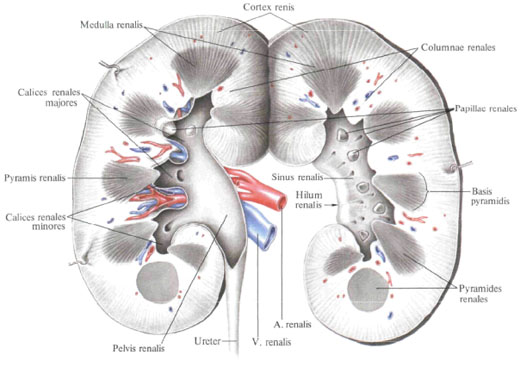
Cortex , cortex renais, has a thickness of 5-7 mm, it seems to border the convex base of the pyramids and gives between them processes directed towards the center of the kidney - kidney posts, columnae renales. The cortical substance consists of two parts: the radiant part, the radis pars, and the rolled part, the convoluta pars. The radiant part is a continuation of the medullary substance from the base of each renal pyramid. The folded part is a portion of the cortical lobe, consisting of the renal corpuscles and the proximal and distal tubules of the nephron, lying between the radiant parts. In the embryonic period and in early childhood, the pyramids with the surrounding cortex, the so-called papal lobes, tobi renales, are clearly visible. In these periods, the kidney looks lobed. With age, the boundaries between the lobules gradually become smoother, while in the cortical substance there are signs of lobulation in the form of cortical lobuli, lobuli corticales.
The tops of the pyramids, merging 2-3 (sometimes up to 6), form renal papillae protruding into the renal sinus, papillae renales. At the top of the papilla are papillary holes, foramina papillaria, from 10 to 55, forming a latticed field, area cribrosa, papilla. The renal papillae are covered with funnel-shaped small kidney cups, calices renales minores, whose number on average reaches 8-9; Sometimes one small cup covers 2 or even 3 papillae. Several small kidney cups are connected to a large kidney cup, calix renalis major; Their 2-4, they are essentially urinary ducts that connect individual groups of small kidney cups to the renal pelvis.


Comments
When commenting on, remember that the content and tone of your message can hurt the feelings of real people, show respect and tolerance to your interlocutors even if you do not share their opinion, your behavior in the conditions of freedom of expression and anonymity provided by the Internet, changes Not only virtual, but also the real world. All comments are hidden from the index, spam is controlled.