

| section Home
Production, Amateur Radio amateur Model aircraft, rocket- Useful, entertaining |
Stealth master
Electronics Physics Technologies invention |
space Mystery
Earth Mysteries Secrets of the Ocean Stealth section Map |
  |
| Use of material is permitted for reference (for websites - hyperlinks) | |||
Navigation: => |
Home / Products Patents / In the section of the catalog / back / |
|

INVENTION
Russian Federation Patent RU2181117

METHOD FOR PRODUCING METHANOL
Name of the inventor: Cherepnova Anna V. (UA); Lander Aida A. (UA); Krasnyanskaya Alevtina G. (UA); Topchiy Viktor Andreyevich (UA); Rozovskii AY (RU); Lin GI (RU); Uglova Anna (UA); Kakichev Alexander Pavlovich (UA); Ovsiyenko Peter V. (UA)
The name of the patentee: State Research and Design Institute of Chemical Technology "Himtehnologiya" (UA)
Address for correspondence: 93400, Lugansk region, Severodonetsk, st.. Vilesova, 1, Institute "Himtehnologiya" P.P.Borisovu Director
Starting date of the patent: 1998.05.19
The invention relates to a process for producing methanol, which is used in the field of organic synthesis. The process comprises contacting a gaseous mixture containing carbon oxides and hydrogen, with a copper catalyst at a temperature of 190-290 o C and a pressure of 5.0-10.0 MPa and space velocity of 4500-100000 hr -1. In this case the feed gas mixture containing 1,0-33,7 vol.% Carbon monoxide, 0,3-22,5 vol.% Carbon dioxide at a volume amount of hydrogen to carbon oxides, 1,91-5,60 equal, a and 0,5-50,0 vol.% nitrogen was passed sequentially through a cascade of flow reactors in a single step. Usually, methanol and water separated after each reactor.
DESCRIPTION OF THE INVENTION
The invention relates to the field of organic synthesis, particularly to the production of methanol from hydrogen and carbon oxides.
A method of producing methanol, which comprises an oxide and carbon dioxide with hydrogen under the reaction pressure of 1,0-15,0 MPa (preferably from 4.0 to 8.0 MPa), a temperature of 160-300 o C (preferably 190 to 270 o C) , 7000-25000 WHSV h -1 in the presence of a catalyst comprising the oxides of copper and zinc, and at least one reducible metal oxide is difficult to second - fourth groups of the periodic system, separation of methanol from the reaction mixture, and recycling the unreacted materials in the synthesis of methanol. As a raw material, a mixture of hydrogen and carbon oxides, and carbon dioxide contained in an amount of 1-20 vol.% (Preferably 3-12 vol.%). The reaction gas is contacted with the catalyst, the volume ratio of hydrogen to carbon oxides in an amount of 1.3-3.0 times the stoichiometric (British Patent 1159095, MKI C 07 C 32/00, h. Of 18.08.65, op. 23.07 .69 g).
The disadvantages of this method are the low specific copper-containing catalyst performance (0,191-0,425 kg / l · hr), and significant energy and cost for recycling the gas mixture.
Known and the method for producing methanol from synthesis gas containing hydrogen and carbon oxides in which the fresh gas fed to a reactor operated without circulating the gas mixture and the unreacted gas after condensation of methanol as the fresh gas fed to the loop reactor syngas. Isothermal flow reactor operates. (Germany 3518362 MKI Application C 07 C 31/04, s. 5.22.85, at op. 27/11/86 was).
The disadvantage of this method is the use of larger capacity compressor for circulating the gas mixture in the second stage and, consequently, a considerable energy consumption.
The closest to the set of attributes to the claimed invention is a process for the production of methanol by contacting a gaseous mixture containing carbon monoxide, carbon dioxide and hydrogen with a copper-containing catalyst at a temperature of 190-290 o C and a pressure of 5-10 MPa in two stages. In the first step the copper-containing catalyst is contacted with a gas mixture comprising 5-30 vol.% Carbon dioxide and 0,3-20,0 vol.% Carbon dioxide at a volume ratio of carbon monoxide to carbon dioxide and a volume ratio 0,25-87 the amount of hydrogen to carbon oxides 2-3,65. This step is carried out in a reactor cascade type or flow at a flow rate of source gas mixture 4500-100000 hr -1 to obtain a gas mixture containing carbon monoxide, carbon dioxide, hydrogen, methanol, and a pair of 0,02-1,38.% water vapor, said pairs of methanol and water is removed from the gas mixture. The remaining gas mixture containing carbon monoxide, carbon dioxide and hydrogen, is fed to the second stage, which is performed in the reactor while circulating a gas mixture at a space velocity hr -1 7000-15000, after receiving the second-stage gas mixture containing carbon monoxide, carbon dioxide, and hydrogen, methanol vapor and water are removed from the gas mixture (WO 88/00580, ICI C 07 C 29/15, s 23/07/87, 28/01/88, the op -.. a prototype).
The disadvantages of this method include low specific productivity of copper-containing catalyst in the second step, component, depending on the synthesis conditions 0,40-0,68 t / m 3 h insignificant contribution methanol obtained in the first step, in general the amount of 5.42 up to 78.33%, a high rate of circulation of the gas mixture. It involves the use of high power compressors, and high costs of energy for the circulation of the gas mixture, which substantially impairs the feasibility of the process. Another drawback of the method is the limited range of the concentrations of the components, which are part of the feed gas mixture. Current methods allow the conversion of hydrocarbons to obtain gases with a high content of carbon and nitrogen oxide than those stated in the prior art for processing in methanol. Since high-temperature conversion of hydrocarbons obtained with gas mixtures containing carbon monoxide of more than 33% and the conversion of vapor -. Gases with a nitrogen content of more than 40 vol.%. Proposed in the prior art method is uneconomical to recycle gases such as methanol with a high content of carbon dioxide (more than 30 vol.%) And a high content of nitrogen, although at industrial sites such a need exists. In the first case, the ratio of the reactants and reduced below stoichiometric conversion of carbon oxides to methanol due to the shortage of hydrogen in the loop. In the second case, using gases with a high nitrogen content dramatically decreases the specific catalyst performance as a result of the low content of reactive components carbon monoxide, carbon dioxide and hydrogen in a gas directly into contact with the catalyst. In this case it is impossible to reach the accepted economic indicators of the process because of the high gas circulation of energy, which is composed mainly of nitrogen - inert component in the methanol synthesis.
The invention is a method for producing objective improvement methanol wherein the process through conduct flow reactors in cascade in one step to exclude energy costs circulation gas mixture and process flow scheme is simplified while maintaining high specific catalyst productivity and high conversion of carbon oxides to methanol.
The problem is solved in that the methanol in the claimed method are prepared by contacting a gas mixture containing carbon oxides and hydrogen, with a copper catalyst at a temperature of 190-290 o C and a pressure of 5.10 MPa and WHSV 4500-100000 h -1, in accordance with invention, the initial gas mixture containing 1,0-33,7 vol.% carbon monoxide, 0,3-22,5 vol.% carbon dioxide by volume hydrogen to carbon oxides 1,91-5,60 amount, and a 0,5-50,0 vol. % Nitrogen is passed sequentially through a cascade of flow reactors, and methanol and water recovered by condensation between the cascade stages,
The essential characterizing features of the proposed method for producing methanol are as follows:
- Methanol prepared in two or more reactors operated without circulating the gas mixture successively interconnected in cascade, with separation of methanol and water after each reactor,
- Feed gas mixture fed to the first flow reactor contains about 1,0-33,7. % Carbon monoxide, 0,3-22,5 vol.% Carbon dioxide at a volume amount of hydrogen to carbon oxides 1,91-5,60 and 0,5-50,0 and vol.% Nitrogen.
As raw material for methanol synthesis can be used gas mixture obtained from various raw materials using a variety of manufacturing processes, off-gases and other industries. Research has shown that for methanol flow reactors in a cascade process gases can widely change the concentrations of the reactants, while achieving high productivity catalyst 0,45-2,85 m CH 3 OH / m 3 h at high conversions of carbon oxides 69.50 to 93.85%. The proposed limit of the ratio of H 2 / CO + CO 2, equal to 1,91-5,60 for the feed gas mixture is selected from the following considerations. Reducing the volume ratio H 2 - / CO + CO 2 less than 1.91 results in reduced conversion of carbon oxides to methanol due to the shortage of hydrogen in the feed gas, wherein the ratio in the following reactors the reactants is removed from the stoichiometric sharply. The upper limit for the volumetric ratio H 2 / CO + CO 2 equal to 5.60, determined by the fact that at higher specific relationship decreases catalyst productivity due to a low content of carbon oxides in the feed gas. The lower limit of the content of carbon monoxide in the feed gas mixture of 1 vol.% Due to the fact that at low concentrations of carbon monoxide water dramatically inhibits the synthesis of methanol, as formed by two reactions, both reaction 1 and in reaction 2, which is due to CO fault occurs in the direction of the hydrogenation of carbon dioxide:
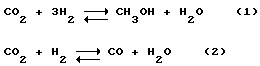
In the case of using a gas with a low ratio of CO / CO 2, as seen from the table, the specific catalyst productivity is reduced, increasing the number of reactors in a cascade of flow, leading to increased capital and operating costs.
The upper limit of the content of carbon monoxide 33.7 vol.% Because at higher contents the reactants CO ratio is much lower than the stoichiometric, which results in lower conversion of carbon oxides to methanol due to the lack of hydrogen in the feed gas. The lower limit of the content of carbon dioxide in the feed gas mixture of 0.3 vol.% Is because the further reduction of CO 2 gas in the methanol synthesis rate rapidly decreases and is generally not in the absence of CO 2, the methanol synthesis reaction (YB Kagan , Rozovskii AY, GI Lin, et al. Kinetics and catalysis, 1975, v. 16, 3, p. 809). Limiting the upper limit for carbon dioxide to 22.5 vol.% Is explained by the same factors that limit and the upper area of carbon monoxide. Furthermore, when a higher content of carbon dioxide in the feed gas by reducing the number of reactors in cascade, if necessary to provide a high carbon oxides drawdown process speed increases. The upper region at up to 50% nitrogen because nitrogen is inert component and increase its concentration in the feed gas pulls a decrease in the content of reactive components - carbon dioxide, carbon monoxide and hydrogen. Thus, the specific catalyst productivity decreases and becomes uneconomical to process gases in a reactor cascade with a high nitrogen content. These adverse effects appear more (with a high nitrogen content - 50%) in the circulation known circuits that require large energy consumption for the gas circulation, which consists essentially of nitrogen.
Search carried out for sources of scientific-technical and patent information has shown that the combination of all the essential features of the claimed technical solution is not known. Therefore it can be assumed that the proposed method of producing methanol meets the requirements of novelty, because It is not known in the art.
Comparative analysis of the essential features of the claimed method and the known signs shows that these signs used for the first time. A whole set of essential features of the claimed technical solution allows to obtain a new result - to simplify the technological scheme and improve technical and economic performance of the process with a high degree of conversion of carbon oxides to methanol. Thus, we can conclude that the claimed method complies inventive step.
The essence of the proposed method is as follows. The feed gas mixture containing 1,0-33,7 vol. % Carbon monoxide. 0,3-22,5 vol.% Carbon dioxide at a volume ratio of H 2 / CO + CO 2 = 1,91-5,60 fed into the heat exchanger under a pressure of 5-10 MPa, which is heated to a temperature of 200 C. The heated gas mixture is fed to the first gas flow along the reactor with intensive heat sink, for example in a tubular reactor. The reactor feed gas is contacted with a copper catalyst such as copper-zinc-aluminum (53.2 wt.% CuO, 27.1 wt.% ZnO, 5.5 wt.% Al 2 O 3) copper or copper-zinc chromium (56.0 wt.% CuO, 25 ± 2 wt.% ZnO, 17 ± 2 wt.% of Cr 2 O 3). During the reaction, water formed and methanol. The heat of reaction is used for example to produce steam that can be used for technological purposes. The temperature of the gas at the outlet of the reactor is slightly higher than the temperature of the feed gas mixture at the reactor inlet. Flow exiting the reactor the gas mixture containing carbon oxides, hydrogen, water and methanol vapor enters the heat exchanger to remove heat therefrom and then separated in a separator, methanol and water. Exiting from the separator gas mixture containing carbon oxides and hydrogen is preheated in a heat exchanger and fed into the second flow reactor. Depending on the process conditions (amount and composition of feed gas space velocity, temperature, pressure) stage may include a different number of reactors - two or more. The parameters of the operation of all the reactors in the cascade is advisable to keep the same as those in the first gas flow along the reactor.
Proof of the proposed method are the following examples.
Example 1 (Comparative)
Methanol was prepared in two steps: the first step in the cascade of three reactors in the second stage reactor recycle gas mixture. The first flow reactor fed feed gas mixture, where it is at a temperature of 251-265 o C and a pressure of 8 MPa and a space velocity of 28,000 h -1 in contact with 10 m 3 copper-containing catalyst. This forms a 24 t / h of methanol. Flow leaving the first reactor after separation of a gas mixture of methanol and water is fed into the second flow reactor, where it is at a temperature of 255-264 o C and a pressure of 8.0 MPa and a space velocity of 22602 h -1 contacted with 10 m 3 copper-containing catalyst. This forms a 22 t / h of methanol. After the second reactor the gas mixture is fed to the third flow reactor. Here at 258-264 o C, a pressure of 8 MPa and a space velocity of 17847 h -1 obtained 18 tons / hour of methanol. Total obtained in the first stage 64 t / h of methanol, reaching a degree of conversion of 56.74% carbon oxides. Unreacted in the first stage after the separation of a gas mixture of methanol and water fed to the second stage in the shaft reactor operating with recycle, wherein at 200-278 o C, a pressure of 8 MPa and a space velocity of 12250 h -1 obtained 34 t / h of methanol. The total amount of methanol produced in the first and second stages is 98 t / h, the specific capacity of 1 m 3 of catalyst 1.09 tons per hour of methanol. The conversion of carbon oxide is 90%. The composition of the gas mixtures and process conditions are given in the table.
Examples 2-11
Methanol was obtained in a cascade of two (Examples 2, 9), three (Examples 3, 4, 8, 10, 11), four (Examples 5, 6) and six (Example 7) of flow reactors. The feed gas mixture under pressure is supplied to the recuperative heat exchanger. The heated gas mixture is fed into a flow tube reactor with intensive heat sink where it contacts the copper-zinc-aluminum catalyst (Examples 2, 4-10) containing 53.2 wt.% CuO, 27 wt.% ZnO, 5,5 wt .% Al 2 O 3, or copper-zinc-chromium catalyst (example 3) containing 56 wt.% CuO, 26 ± 2 wt.% ZnO, 17 ± 2 wt.% Cr 2 O 3. After cooling the gas stream and condensing gaseous methanol and water mixture in a certain amount of heated and fed into the second flow reactor, where it is again contacted with the catalyst, etc. Terms of processes, consumption ratios and specific performance are shown in the table.
From the examples in Table seen that the inventive method makes it possible to process gas mixtures in methanol obtained by any known hydrocarbon conversion methods, or off-gases, wherein the concentration range is extended as the reactants to 33.7 vol.% Carbon monoxide vs. 30 vol. % In the prior art, and up to 22.5 vol.% Carbon dioxide to 20 vol. % In the prior art, and inerts up to 50% nitrogen in the starting gas mixtures. From the examples and it is evident that the specific productivity of the catalyst to methanol is 0,45-2,84 m / m 3 per hour, that is equal to or higher than that of the prototype (0,52-1,09 m / m 3 per hour) and several times the value of the specific catalyst productivity that is achieved in modern technology. In modern industrial plants producing methanol specific productivity of the catalyst is relatively low from 0.1 to 0.3 t / m 3 hours under a pressure of 5 MPa and up to 0.4 t / m 3 hr under a pressure of 8 MPa. Furthermore, in the present process in the absence of recycling the gaseous mixture of raw materials, a high degree of processing in methanol (70-94%) due to the fact that the removal of the reaction products (methanol and water) between thermodynamic cascade stages braking process eliminates them. In order to reduce the braking circuit traditional process the reaction products and to achieve almost complete (85-95%) recycling the carbon oxides to methanol, the synthesis must be conducted at high speeds of gas circulation and cycle intensive conclusion of liquid products, which requires significant energy. The number of reactors in the cascade and the unit volume of the reactor depends on the gas composition and the catalyst activity. Input or output of one of the reactors in the cascade can easily adjust the capacity of the plant, given the demand for opportunistic methanol.
Implementation of the proposed method in a cascade of flow reactors distinguishes it from other known processes, as it allows to completely eliminate gas circulation power consumption, simplify the process technology.
CLAIM
A method of producing methanol by contacting a gas mixture containing carbon oxides and hydrogen, with a copper catalyst at a temperature of 190-290 o C and a pressure of 5.0-10.0 MPa and space velocity of 4500-100000 hr -1, wherein the initial gas mixture containing 1,0-33,7 vol.% carbon monoxide, 0,3-22,5 vol.% carbon dioxide by volume hydrogen to carbon oxides sum equal 1,91-5,60 and 0.5 and -50.0 vol.% nitrogen was passed sequentially through a cascade of flow reactors in a single step.
The method of claim 1, wherein the methanol and water separated after each reactor.
print version
Publication date 01.01.2007gg


Comments
Commenting, keep in mind that the content and the tone of your messages can hurt the feelings of real people, show respect and tolerance to his interlocutors, even if you do not share their opinion, your behavior in terms of freedom of speech and anonymity offered by the Internet, is changing not only virtual, but real world. All comments are hidden from the index, spam control.