

home
 Management
Organization of production - Kurochkin A.S. Management
Organization of production - Kurochkin A.S.
|
Organization of production - Kurochkin A.S.
2.2. Organization of the production process in space (types and methods of organization of production)
Organizational types of production
Industrial enterprises vary in many respects - the structure and volume of output, its breadth and stability of the nomenclature, etc. Depending on these indicators, workplaces, sectors, shops and enterprises are divided into several organizational types of production.
The type of production determines the structure of enterprises and shops, the nature of the workload and the movement of labor objects in the production process. Each type of production has certain characteristics of the organization of the production process and labor, the equipment and technological processes used, the composition and qualifications of the staff, etc. Each type of production has a certain planning and accounting system.
The type of production is a complex characteristic of the organizational and technological level of production, i.e. The totality of the range of products, the volume of production, the frequency of production, the type of workplace utilization, the type of equipment used, the qualifications of workers, the cost of production,
There are three main types of production: single, serial and mass (Table 8).
A single type of production is characterized by a wide range of manufactured products and a small output of identical products. Technological processes and standards are developed with an indication of inter-shop technological routes and the necessary equipment, refined and finalized in workshops and workplaces. Equipment, tools and devices, as a rule, are universal; Ensure the performance of various works of a particular profile of the enterprise. The equipment is located in groups of the same type of machine tools. Improvement of the technological process in the workplace requires the use of labor of highly skilled workers.
Enterprises with a single type of production are designed to manufacture unique equipment (rolling mills, turbines
Table 8
COMPARATIVE TECHNO-ECONOMIC CHARACTERISTICS OF PRODUCTION TYPES
| Parameter | Type of production single serial mass |
||
1. Specialization of workplaces |
Different operations |
Periodically repeating operations |
One or two repetitive operations |
2. Nomenclature of products |
"Broad", unlimited |
Limited by series |
"Narrow", one or more species |
3. Equipment and its arrangement |
The universal, technological principle |
Part of the equipment is specialized; Subject-technological principle |
Special, objective principle; Automatic lines |
4. Tooling |
Universal |
Used on a large scale |
Special |
5. Qualification of workers |
High |
Average |
Low |
6. Coefficient of use of metals |
0.40-0.60 |
0.60-0.80 |
0.80-0.95 |
|
7. Level Automation of production |
Up to 0,20 |
0.40-0.70 |
0.90-0.99 |
8. Labor intensity and cost of manufacturing a unit of production |
High |
Average |
Low |
9. Quality of products |
Satisfactory |
Above average |
Good |
Etc.), special equipment (stamps, molds, devices), products of pilot production and samples of new equipment. The coefficient of metal use here is very low (0.4-0.6), the level of automation of production processes is also very low.
The serial type of production is characterized by the production of a limited range of products, which is periodically repeated. Products are launched in production series, parts are handled in batches. (A series refers to the number of constructively technologically identical products that are put into production simultaneously or sequentially.) The production of products in series allows you to fix a number of parts (operations) for workplaces for permanent or periodically repeating execution.
This specificity of the serial type of production leads to the fact that, along with universal equipment, a specialized workplace is widely used, and jobs are to a large extent specialized. Widely used quickly-machine-tools, manipulators, etc. All this contributes to higher labor productivity, reducing the duration of the production cycle.
In addition, in series production, a technological process is developed in detail, which allows to reduce allowances for processing and to increase the accuracy of workpieces. All this leads to an increase in the metal utilization factor - up to 0.80.
Serial production is divided into three subtypes: small-scale, medium-series and large-scale. According to technical and economic characteristics, small-scale production is approaching a single production, and a large-scale production is approaching a mass production.
For mass production, the nomenclature of output is characteristic for large-scale production (cars, tractors, etc.). At the same time, special equipment, tools, and technological equipment are used. Widely used machine-tools and automatic lines. Workers perform a very limited number of operations.
The technological process is developed in great detail and carefully for each operation, indicating the modes of operation of the equipment, the tools used, the time and materials standards (the coefficient of using metals reaches 0.95). Equipment is located along the process, using a parallel method of combining operations. This contributes to a significant reduction in the duration of the production cycle, the size of the stockpile, and the reduction in costs of production.
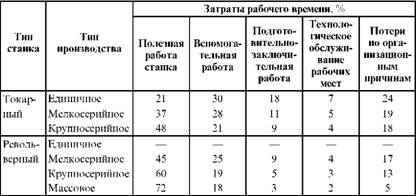
An approximate structure of the cost of working time for individual types of machines and different types of production is given in Table. 9.
Each type of production corresponds to certain methods of its organization.
Table 9
EXAMPLE STRUCTURE OF WORKING TIME EXPENDITURE DEPENDING ON PRODUCTION TYPE [20]


Comments
Commenting on, remember that the content and tone of your message can hurt the feelings of real people, show respect and tolerance to your interlocutors even if you do not share their opinion, your behavior in the conditions of freedom of expression and anonymity provided by the Internet, changes Not only virtual, but also the real world. All comments are hidden from the index, spam is controlled.